
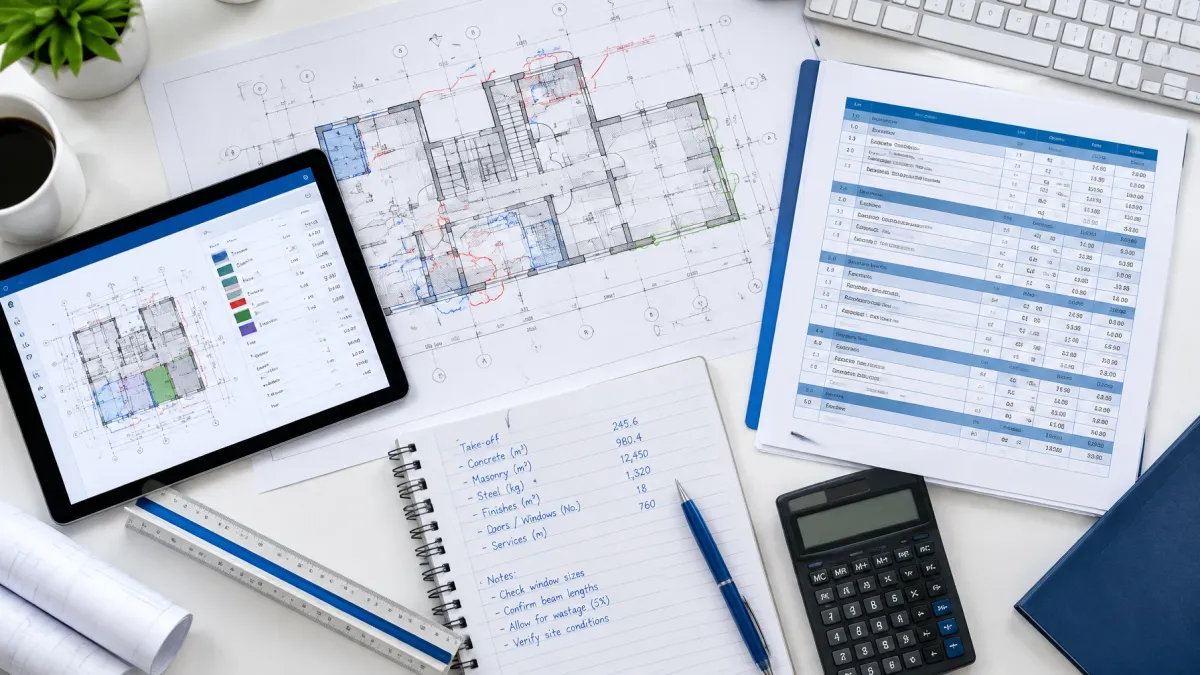
How to Price a Construction Tender in 2026: A Step-by-Step Guide for UK Builders
Pricing a construction tender in 2026 requires more than applying a broad rate per square meter. Labour, materials, plant, subcontractor costs, preliminaries, overheads and profit all need to be assessed against the project scope and current market conditions.
UK tender prices are forecast to rise by approximately 2.8% to 4.5% during 2026, depending on the sector, location, project type and level of risk. Material prices are also moving in different directions. Structural steel has seen sharp increases in some market data, including reported rises of around 17.7%, while concrete-related prices have been softer in some categories.
For contractors, the objective is to submit a competitive tender without accepting unnecessary margin risk. This guide explains a structured approach to construction tender pricing for UK builders and contractors.
What Should a Construction Tender Include?
A complete tender price usually includes:
Measured quantities
Labour costs
Material costs
Plant and equipment
Subcontractor packages
Site preliminaries
Design and temporary works allowances
Business overheads
Risk allowances
Profit
VAT, where applicable and relevant to the quotation
The exact structure will depend on the procurement route, contract requirements and information provided.
A tender based only on drawings and a single overall allowance may leave important costs hidden. A structured estimate makes it easier to review the project, compare supplier quotations and identify areas of uncertainty.
STEP 1: REVIEW THE TENDER INFORMATION
Begin by collecting and reviewing all available project information.
This may include:
Architectural drawings
Structural drawings
Mechanical and electrical information
Specifications
Schedules
Existing Bills of Quantities
Scope of works
Preliminaries information
Programme requirements
Employer’s requirements
Supplier and subcontractor quotations
Tender return instructions
Check that the documents are current and consistent. Note any differences between drawings, specifications and schedules.
You should also identify:
Missing drawings
Unclear specifications
Provisional sums
Prime cost items
Design responsibilities
Exclusions
Access restrictions
Working-hour limitations
Phasing or occupation requirements
If information is incomplete, record the issue and make a clear assumption or allowance. Do not treat uncertain information as a confirmed scope item.
A professional construction estimating service can help review the documents and identify the information needed before pricing begins.
STEP 2: PREPARE OR CHECK THE BILL OF QUANTITIES
A Bill of Quantities, or BOQ, is a measured schedule of the works required to complete the project.
It normally includes:
Item | Description | Quantity | Unit | Rate | Total |
|---|---|---|---|---|---|
A BOQ helps you price a defined scope instead of relying on visual judgement from drawings. It can also reduce the risk of missing smaller items that may become expensive once the project starts.
Where you already have a BOQ, check:
The measurement basis
The descriptions
The units
The quantities
The work sections
The inclusion of preliminaries
The treatment of provisional sums
The relationship between the BOQ and the latest drawings
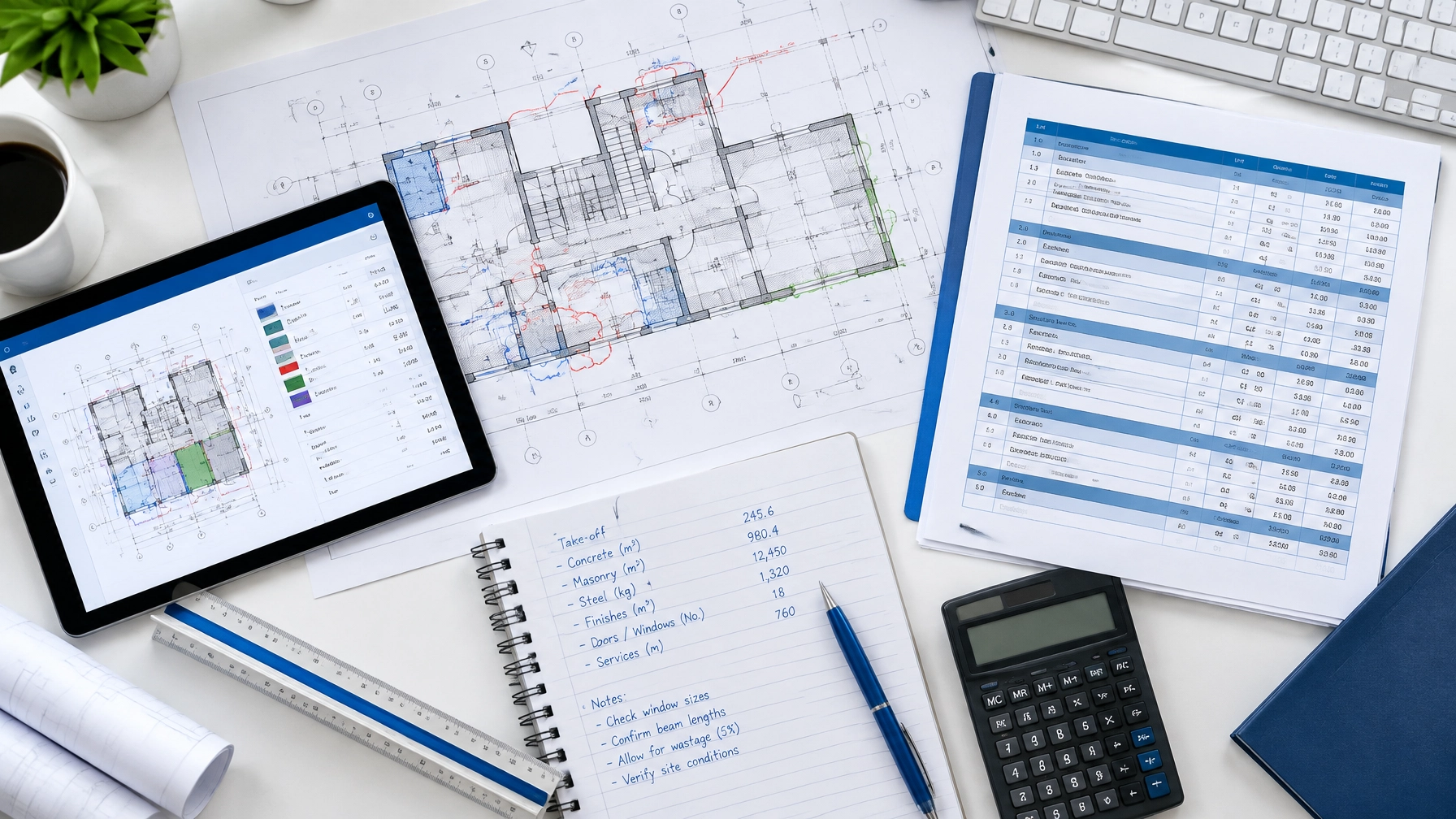
Where no BOQ exists, a detailed quantity take-off may be required first. Estimate Exact provides Bills of Quantities for UK builders and contractors, prepared from drawings, specifications and schedules.
STEP 3: BUILD UP LABOUR COSTS
Labour should be priced against the actual work involved rather than a broad project allowance wherever sufficient information is available.
For each work item, consider:
Trade required
Quantity
Expected output
Number of operatives
Labour rate
Working conditions
Access and handling requirements
Expected duration
Supervisory requirements
A basic labour calculation is:
Quantity ÷ expected output = labour hours required
You can then apply the appropriate hourly or daily labour rate.
Allow for the project location, trade availability, travel, accommodation, overtime and any specialist requirements. Labour shortages can affect both rates and programme. A low labour allowance may make the tender appear competitive but create a shortfall during delivery.
Labour should also be reviewed against the programme. A compressed programme may require additional labour, supervision, shifts or temporary facilities.
STEP 4: PRICE MATERIALS USING CURRENT INFORMATION
Material prices should reflect the expected procurement date and project requirements.
Use:
Current supplier quotations
Agreed account rates
Recent subcontractor information
Manufacturer pricing
Delivery charges
Waste allowances
Handling requirements
Storage requirements
Material escalation assumptions
Avoid applying one blanket percentage to every material. The 2026 market is not moving uniformly.
For example:
Structural steel may require a specific risk review where supplier prices have increased sharply.
Concrete prices may be flat or lower in some categories.
Cement, reinforcement, precast products and other concrete-related materials may follow different trends.
Imported products may be affected by shipping, currency and energy costs.
Mechanical and electrical equipment may have long lead times and changing manufacturer pricing.
If a project contains a significant steel frame, obtain current supplier information where possible. A reported increase of approximately 17.7% in structural steel should not automatically be applied to the complete tender. It should be tested against the actual steel specification, supplier quotations and expected delivery period.
Similarly, if concrete pricing has reduced in a relevant category, confirm that the reduction applies to the required grade, volume, location and delivery conditions.

STEP 5: INCLUDE PLANT AND EQUIPMENT
Plant costs are often missed or placed into a general allowance that does not reflect the programme.
Review the need for:
Excavators
Dumpers
Telehandlers
Cranes
Hoists
Access equipment
Scaffolding
Temporary works equipment
Small tools
Specialist plant
Fuel and delivery costs
For each item, consider the hire period, mobilisation, demobilisation, operator requirements, servicing, fuel and potential extensions.
Longer programmes can increase plant costs even when the original scope does not change. Site access and restricted working areas may also require smaller or specialist equipment.
STEP 6: OBTAIN AND CHECK SUBCONTRACTOR PRICES
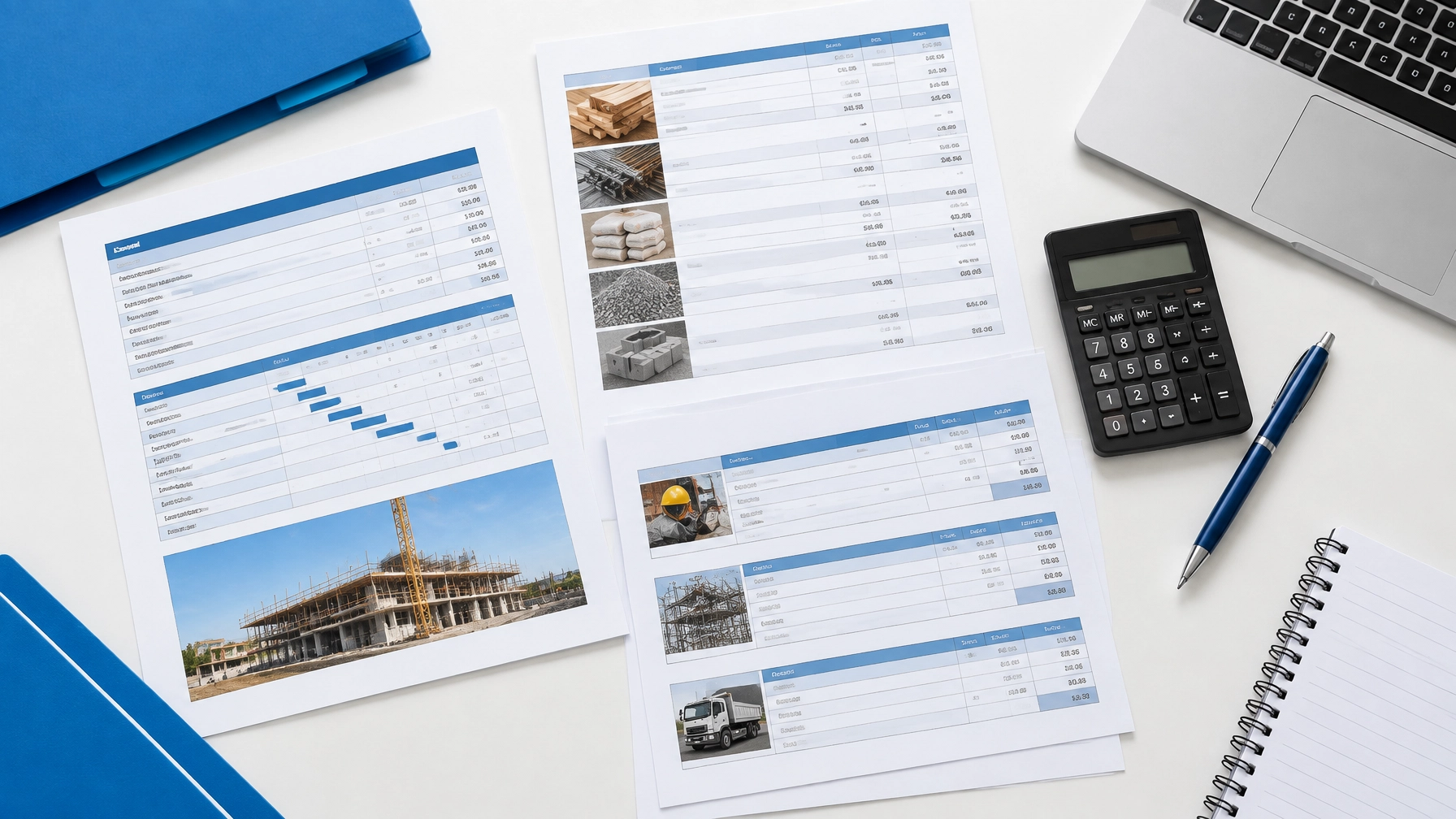
Subcontractor packages should be issued against a clear and consistent scope.
Your enquiry should identify:
Relevant drawings
Specifications
Measured quantities
Programme dates
Site conditions
Access arrangements
Temporary works responsibilities
Testing and certification
Insurance requirements
Design responsibilities
Attendance requirements
Compare returned quotations carefully. A lower price may exclude items included by another subcontractor.
Check whether each quotation includes:
Labour
Materials
Plant
Delivery
Waste
Protection
Testing
Design
Preliminaries
Overheads and profit
VAT
Where quotations are not available, include a realistic subcontract allowance and identify it as an assumption. Update the allowance if better information becomes available before tender submission.
STEP 7: ALLOW FOR PRELIMINARIES
Preliminaries cover the costs of managing and supporting the project. They should be linked to the programme and site requirements.
Typical items include:
Site management
Site supervision
Welfare facilities
Temporary services
Security
Hoarding and fencing
Site accommodation
Health and safety requirements
Temporary roads and access
Surveys and inspections
Traffic management
Waste management
Cleaning
Testing and commissioning
Handover documentation
A six-month project and an eighteen-month project will not have the same preliminaries cost. Review the expected programme, site constraints and client requirements before applying an allowance.
STEP 8: ADD OVERHEADS, RISK AND PROFIT
Once the direct costs have been built up, add the costs required to operate the business and deliver the contract commercially.
Business overheads
These may include:
Estimating and commercial management
Office costs
Insurance
Finance costs
Software
Vehicles
Training
Administration
Company management
Risk allowances
Consider risks such as:
Incomplete design information
Ground conditions
Material price changes
Labour availability
Long lead items
Programme delay
Restricted access
Interface issues
Design development
Planning or approval delays
Regulatory requirements
Profit
Profit should reflect the project risk, contract terms, client requirements, workload and market conditions. A competitive tender should not be achieved by removing the allowance needed to manage identifiable risk.
The BCIS tender price index update for the second quarter of 2026 reported annual tender price growth of 3.2%. It also noted pressure from materials, skilled labour shortages, fuel, plant and supply-chain risk.
Use market forecasts as a reference point, not as a replacement for project-specific pricing.
STEP 9: TEST THE 2026 TENDER AGAINST DIFFERENT SCENARIOS
For projects with a long procurement or construction period, test the effect of different assumptions.
For example:
Lower scenario: 2.8% tender price movement
Base scenario: 3.3% to 3.5%
Higher scenario: 4.0% to 4.5%
Specific material scenario: additional allowance for steel, imported products or specialist equipment
The Knight Frank 2026 tender price index forecast 3.3% tender price inflation for the UK and London. Other market forecasts provide a wider range, reflecting uncertainty around demand, labour, regulation, logistics and materials.
Record which scenario has been used and why. If the project is steel-intensive, infrastructure-related or based on early design information, the higher scenario may require closer consideration.
A SIMPLE TENDER PRICING EXAMPLE
Assume the following direct costs:
Labour: £400,000
Materials: £650,000
Plant: £100,000
Subcontractors: £500,000
Direct cost subtotal: £1,650,000
You then add:
Preliminaries: £200,000
Risk allowance: £82,500
Overheads: £99,000
Profit: £132,000
Illustrative tender total: £2,163,500
This is only an example. The correct allowances depend on the project scope, programme, contract and information available.
HOW ESTIMATE EXACT SUPPORTS TENDER PRICING
Estimate Exact provides structured estimating support for UK builders, main contractors and subcontractors.
We can prepare:
Quantity take-offs
Bills of Quantities
Labour cost build-ups
Material pricing
Plant allowances
Subcontractor costs
Preliminaries
Fully priced construction estimates
Contractor tender estimates
Professionally formatted tender documents
Client-facing quotations
Our process is straightforward:
Send us your documents
Provide your drawings, specifications, schedules, tender documents and any supplier or subcontractor quotations.Approve our quotation
We review the scope, confirm a fixed fee and agree the delivery date before work begins.Receive your estimate
We return a clear, professionally formatted estimate suitable for tender review, pricing decisions and client submission.
You can use Estimate Exact for a single tender, a busy tender period or ongoing additional estimating capacity. Visit our construction estimating services page to submit your documents.
FINAL CHECKLIST BEFORE SUBMITTING YOUR TENDER
Before returning the tender, confirm that you have:
Priced the latest drawing issue
Checked the specification and schedules
Measured the required work
Included labour, materials, plant and subcontractors
Checked supplier and subcontractor exclusions
Allowed for preliminaries
Reviewed the programme
Identified assumptions and clarifications
Considered 2026 material and tender price movement
Included overheads, risk and profit
Checked VAT and tender instructions
Reviewed the final total against the project scope
A structured tender estimate helps you understand what you are committing to before submission. It also gives you a clear record of the assumptions, allowances and costs supporting your tender.
FAQs
What is construction tender pricing?
Construction tender pricing is the process of calculating the cost of delivering a defined construction project. It normally includes labour, materials, plant, subcontractors, preliminaries, overheads, risk and profit.
Should I apply one inflation percentage to the whole tender?
No. A general tender price allowance can provide a starting point, but materials and labour may move differently. Review steel, concrete, imported products and specialist equipment separately where appropriate.
Can Estimate Exact price an existing Bill of Quantities?
Yes. We can review and price an existing BOQ or prepare a new measured BOQ from your drawings and specifications.
What information do you need?
Ideally, send architectural and structural drawings, specifications, schedules, tender documents, programme information and any supplier or subcontractor quotations. If information is incomplete, we can identify assumptions and allowances.
Do you provide estimating services for builders across the UK?
Yes. Estimate Exact provides remote estimating support for builders, contractors, subcontractors and construction professionals throughout the UK.
How do I request a quotation?
Send us your drawings and tender documents. We will review the requirements and confirm the scope, fixed fee and expected delivery date before starting work.