

How to Choose the Best Construction Cost Estimator in the UK (Compared)
Introduction:
Choosing the right construction cost estimator can affect more than the quality of your tender.
It can influence your workload, pricing decisions, profit margin and confidence when committing to a project.
For UK builders and contractors, the main options are usually:
An in-house estimator
A freelance estimator
An outsourced construction estimating service
There is no single option that suits every business. The right choice depends on your tender volume, project types, internal resources and the level of detail required.
This guide compares each option and provides a practical checklist to help you choose appropriate construction estimating services in the UK.
What Does a Construction Cost Estimator Do?
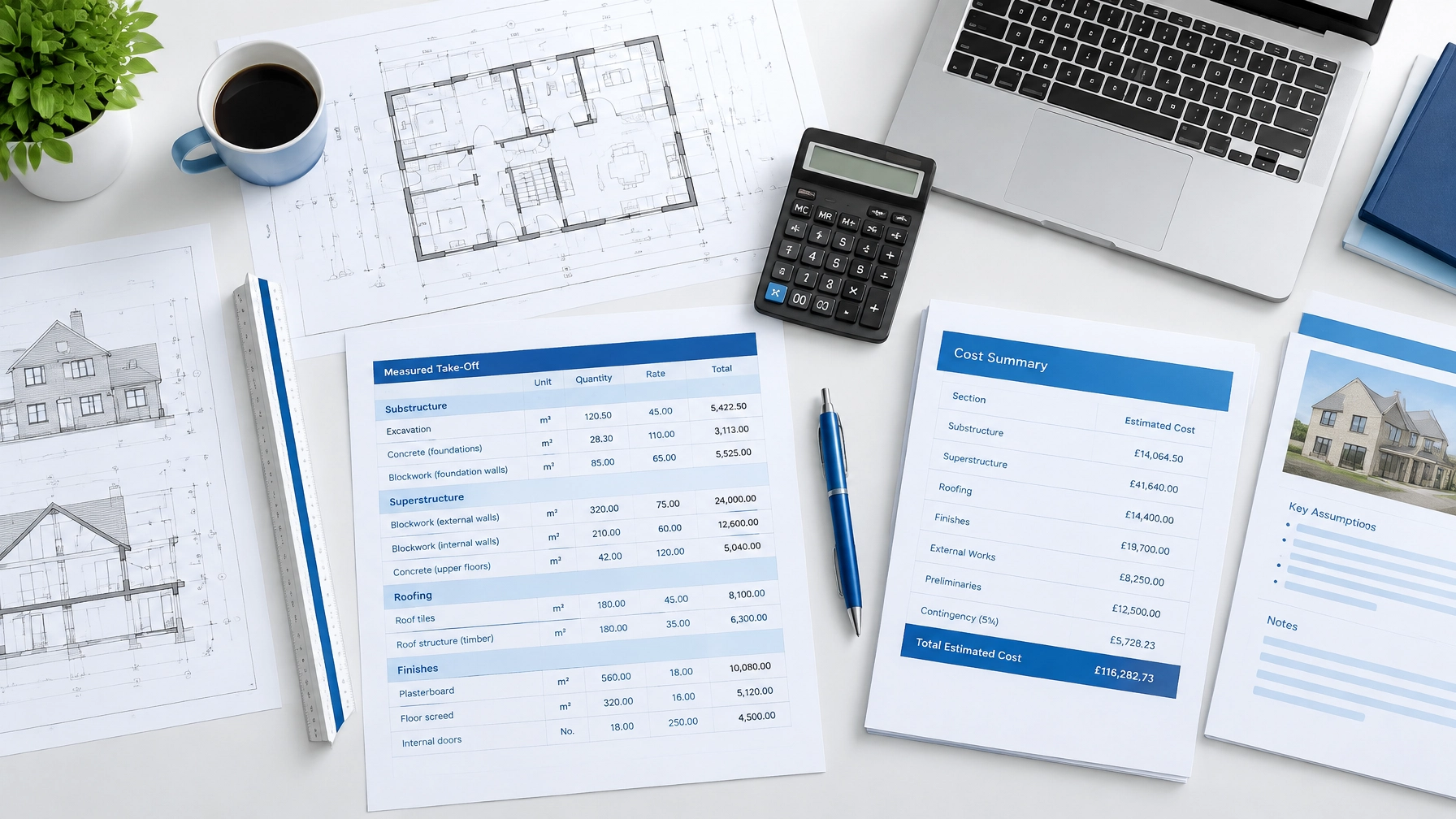
A construction cost estimator reviews project information and calculates the likely cost of completing the works.
Depending on the project, this may include:
Measuring quantities from drawings
Preparing a Bill of Quantities
Pricing labour and materials
Allowing for plant and equipment
Obtaining or incorporating subcontractor quotations
Applying preliminaries, overheads and profit
Identifying assumptions, exclusions and unclear information
Preparing a tender or client-facing quotation
A reliable estimate should be based on the information available. Where the drawings or specifications are incomplete, a professional estimator should identify assumptions rather than presenting uncertain figures as exact.
A useful estimate should also be clear enough for you to review, amend and use in your tendering process.

In-House Estimating Compared
An in-house estimator is employed directly by your business. They work within your systems and become familiar with your suppliers, labour rates, preferred subcontractors and commercial approach.
In-house estimating is suitable when:
You price tenders regularly
You have a consistent project pipeline
You need an estimator available every working day
Your projects require frequent internal communication
You want to build and retain historical cost information
You have enough work to justify a permanent salary
Main advantages
An in-house estimator can develop a strong understanding of your business. They may know how you prefer to build, which suppliers you use and what margins you normally apply.
Communication can also be direct. Your estimator can speak with site managers, directors and project teams without relying on an external handover.
Main limitations
The main limitation is the fixed overhead. You remain responsible for salary, National Insurance, pension contributions, training, software and other employment costs even when tender activity reduces.
Capacity can also become a problem. If several tenders arrive together, one estimator may not have enough time to complete all of them properly. Recruitment can take time, particularly when you need experience across different project types.
Freelance Estimators Compared
A freelance estimator is usually engaged for a specific project, period or number of working days. This can provide flexibility without the cost of employing a permanent member of staff.
Freelance estimating is suitable when:
Your tender workload changes from month to month
You need support for occasional larger projects
You require a specialist for a particular trade or sector
Your business does not need a full-time estimator
You want to supplement an existing estimating team
Main advantages
A freelancer can be a practical option for one-off support. You can engage them when required and avoid the ongoing overhead of a permanent employee.
Some freelance estimators also bring experience from specific sectors, such as residential refurbishments, commercial fit-outs, groundworks or mechanical and electrical packages.
Main limitations
Capacity depends on one individual. If they are unavailable, fully booked or unable to complete the work, you may need to find another person at short notice.
Quality and working methods can also vary. Before appointing a freelancer, you should check relevant experience, sample documents, references, availability and the proposed pricing method.
You should also confirm who is responsible for checking the completed estimate and how revisions will be managed.
Outsourced Construction Estimating Services Compared
An outsourced estimating service provides estimating support from an external business. This can include a single tender, a busy period or an ongoing arrangement.
Outsourcing is often suitable for builders and contractors that need additional capacity without employing another estimator.
Outsourced estimating is suitable when:
Several tenders arrive at the same time
Your existing estimator is already at capacity
You do not have an in-house estimating function
You need detailed take-offs or Bills of Quantities
You are pricing a project outside your usual experience
You want to tender for more opportunities
You need an independent cost check
You require a professionally presented tender document
Main advantages
A structured estimating service can provide a defined process from document review through to final delivery. Depending on the provider, you may receive quantity take-offs, Bills of Quantities, labour and material build-ups, plant costs and subcontractor allowances.
You can also scale the service to match your workload. This may be more practical than maintaining a permanent position for occasional requirements.
The main point to assess is not simply whether the service is outsourced. You should understand who will complete the work, how the estimate will be prepared, what information is included and how the team will communicate with you.

In-House, Freelance or Outsourced: A Practical Comparison
Option | Best Suited to | Main Benefits | Points to check |
|---|---|---|---|
In-house estimator | Businesses with steady tender volumes | Strong internal knowledge, direct communication and consistent processes | Employment cost, recruitment, software and capacity during busy periods |
Freelance estimator | Occasional or specialist estimating requirements | Flexible engagement and access to individual expertise | Availability, continuity, quality checks and scope of work |
Outsourced estimating service | Builders and contractors needing scalable support | Defined process, additional capacity and project-based costs | Who prepares the work, delivery date, fee structure and document quality |
For some businesses, a hybrid approach is appropriate. You may retain an in-house estimator for routine work and use an outsourced service for larger, complex or time-sensitive tenders.
What to Look for in a Construction Cost Estimator UK
Whether you choose an employee, freelancer or estimating company, assess the following areas.
1. Relevant Project Experience
Ask whether the estimator has worked on projects similar to yours.
Relevant experience may include:
House extensions and new-build homes
Residential refurbishments
Housing developments and apartments
Commercial refurbishments
Offices, retail units and warehouses
Fit-out projects
Groundworks and structural packages
Specialist subcontract works
An estimator should understand the type of work being measured and the practical requirements of tender pricing.
2. Clear Measurement and Pricing Methods
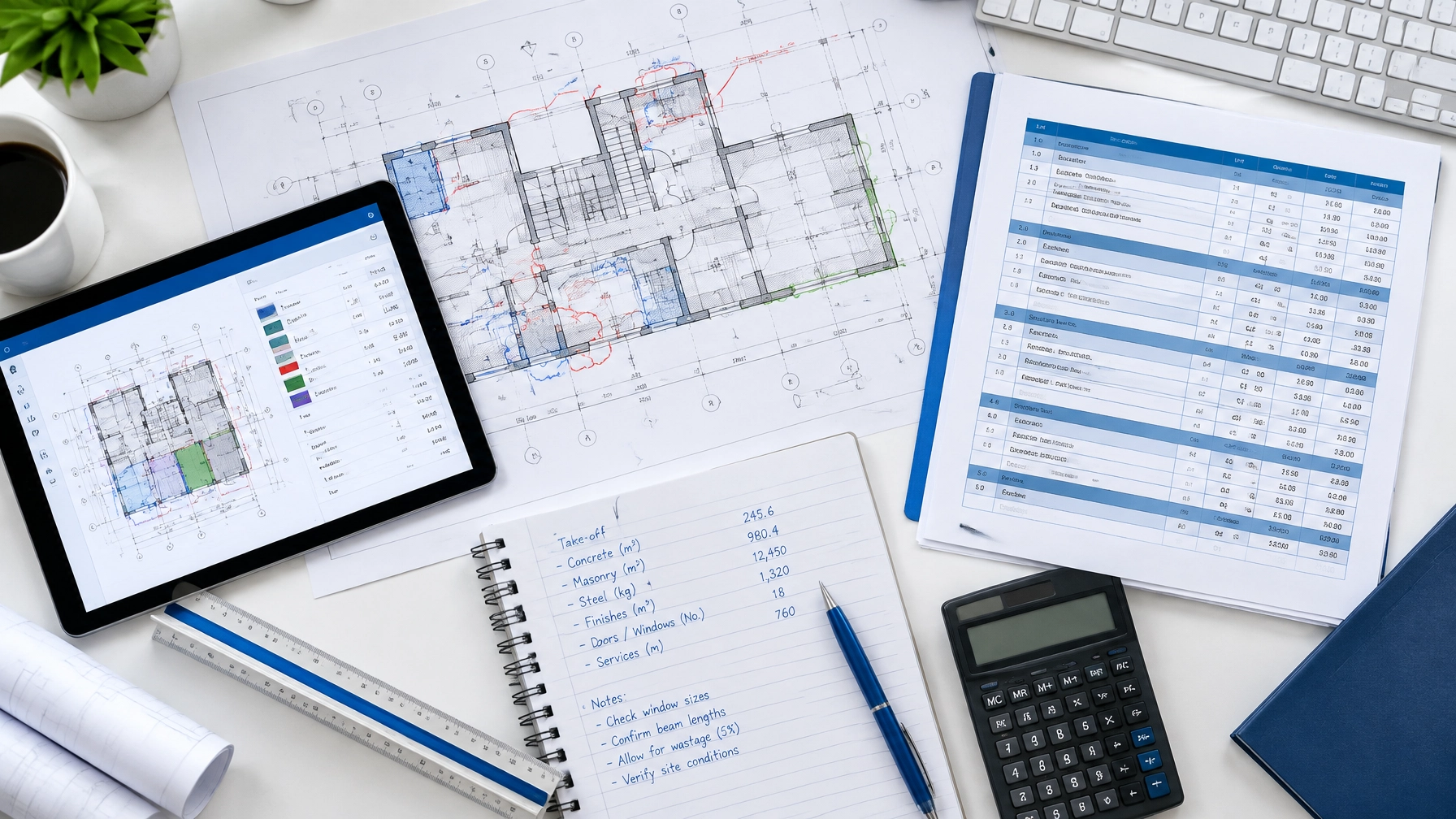
Ask how quantities are measured from drawings and specifications. A detailed estimate should not rely only on broad square-metre allowances where sufficient information is available.
Check whether the estimator can provide:
Digital quantity take-offs
Detailed Bills of Quantities
Labour cost build-ups
Material costs
Plant and equipment allowances
Subcontractor costs
Preliminaries and other agreed allowances
Assumptions and exclusions
Estimate Exact explains its approach to quantity take-offs and Bills of Quantities, including structured descriptions, quantities, units and pricing columns.
3. Current Pricing Information
Construction prices change. Ask how labour, materials, plant and subcontractor rates are obtained and updated.
You should also confirm whether the estimator can incorporate:
Your supplier quotations
Existing subcontractor quotations
Regional pricing differences
Your preferred labour rates
Your agreed overhead and profit structure
Live supplier pricing can help produce a more realistic tender position than relying on old or generic rates.
4. Defined Scope and Assumptions
The estimator should confirm what is included before work begins.
This is particularly important where:
Design information is incomplete
Specifications are still developing
Drawings contain inconsistencies
Certain trade packages are excluded
Provisional sums or allowances are required
Assumptions should be documented clearly so you can review them before submitting the tender.
5. Fixed Pricing and Delivery
Ask for the estimating fee and expected delivery date in writing.
A clear proposal should confirm:
The work to be completed
The documents to be provided
The agreed fee
The expected delivery date
Any exclusions
The process for revisions or additional information
Estimate Exact reviews your drawings, specifications and tender documents before confirming a fixed fee and delivery date. This allows you to understand the cost of the service before work starts.
Why Contractors Use Estimate Exact
Estimate Exact provides construction estimating services for UK builders, contractors, subcontractors and construction professionals.
The service is designed to provide additional estimating capacity without the overhead of employing another full-time estimator.
Each project is reviewed individually. Work is prepared by skilled in-house estimators rather than generic templates or external agencies.
Depending on your requirements, your completed documents may include:
Detailed quantity take-offs
Bills of Quantities
Fully priced construction estimates
Labour, material, plant and subcontractor costs
Live supplier pricing
Assumptions and clarifications
Client-facing quotations
Professionally formatted tender documents
You receive direct support from the Estimate Exact team throughout the process. The service can be used for one-off tenders, busy periods or ongoing estimating support.
You can also review the separate construction cost planning service when you need an early-stage budget before detailed tender information is available.
Practical Checklist for Choosing Estimating Services UK
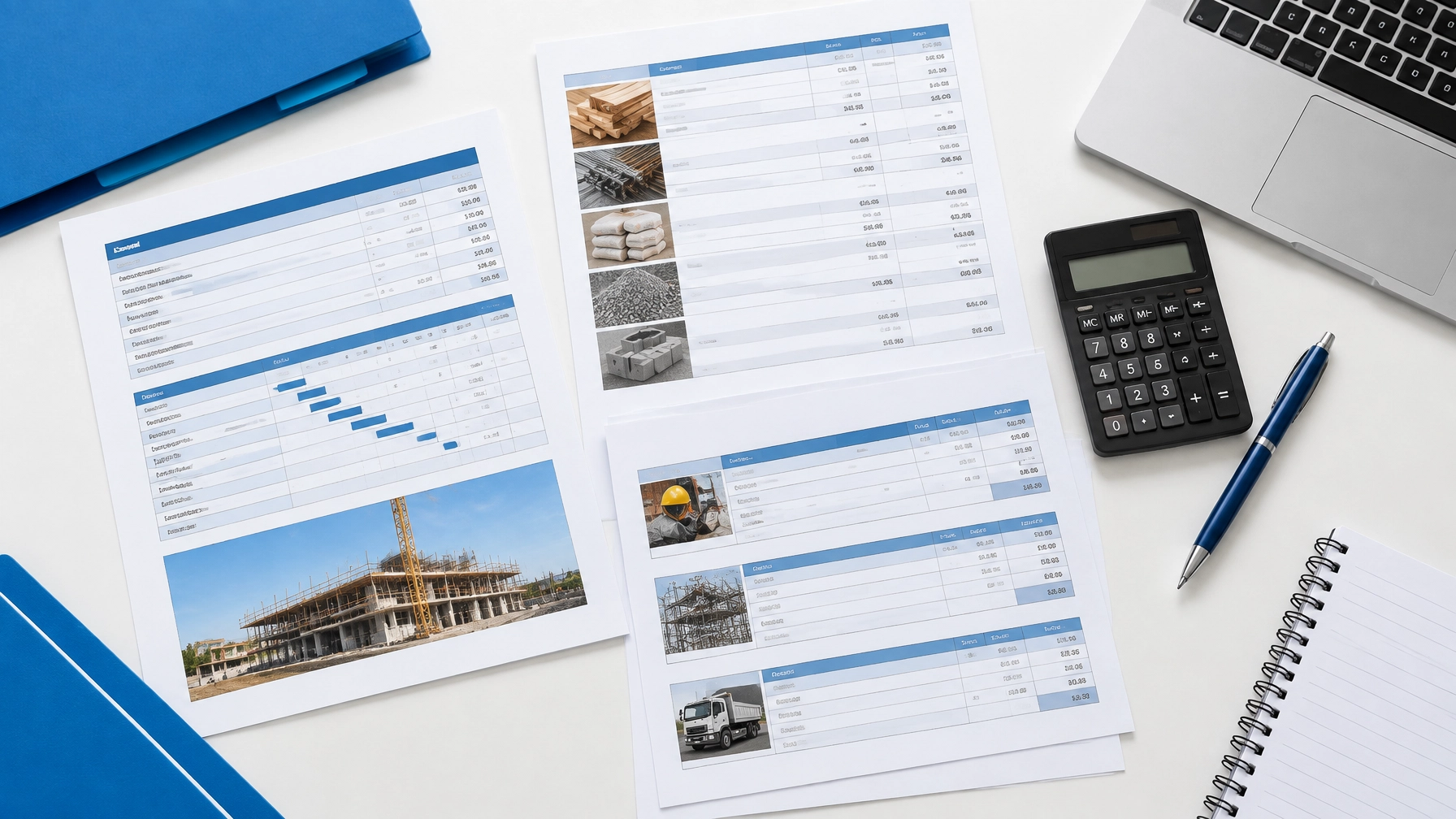
Before appointing a construction cost estimator, confirm the following:
Do they have experience with projects similar to yours?
Can they measure from drawings and specifications?
Can they prepare a Bill of Quantities if required?
Do they price labour, materials, plant and subcontractor costs separately?
Do they use current supplier and construction market information?
Can they incorporate your existing quotations?
Will assumptions and exclusions be documented?
Is the scope of work clearly defined?
Is the fee fixed before work begins?
Is the delivery date agreed in advance?
Will the final documents be professionally presented?
Can you contact the estimating team directly?
Can they support one project or ongoing requirements?
Are the documents suitable for tendering, budgeting or client presentation?
If several answers are unclear, ask for clarification before approving the work.
How the Estimate Exact Process Works
Estimate Exact follows a straightforward three-stage process:
Send your documents
Provide your drawings, specifications, schedules, tender documents and any existing quotations.Approve the quotation
The team reviews your requirements, confirms the scope, provides a fixed fee and agrees the delivery date.Receive your estimate
You receive a clear, professionally presented estimate suitable for tendering, budgeting, subcontract enquiries or project planning.
Ready to Choose the Right Estimator?
The best construction cost estimator for your business is the one that matches your workload, project requirements and internal processes.
An in-house estimator may be appropriate for a consistent pipeline. A freelancer can suit occasional or specialist work. An outsourced estimating service can provide structured, scalable support when you need additional capacity.
If you need a clear construction estimate, quantity take-off or Bill of Quantities, send your drawings to Estimate Exact. We will review the available information and confirm the scope, fixed fee and delivery date before work begins.